April 11, 2017

Female Cosmetic Genital Surgery: Concepts, Classification and Techniques

Dr. Hamori's book is now available from Thieme Medical Publishers and amazon.com

Female Cosmetic Genital Surgery: Concepts, classification and techniques (by Christine A. Hamori, Paul E. Banwell and Red Alinsod) provides a comprehensive guidance for surgeons who perform genital cosmetic treatments for their female patients. It is an invaluable resource with 350 color photos and surgical illustrations, videos and more, with the objective of achieving the best possible outcomes.

From the Preface, Dr. Hamori writes…
"During the late 1990s, when I was fresh out of my plastic surgery residency, I met a young woman who requested a reduction of her labia minora. She felt uncomfortable in her clothes and was embarrassed to be intimate. My first thought was that she must have a body dysmorphic disorder… After I examined her, I understood her concern. Her labia minora were large and protrusive."

"I agreed to perform labiaplasty, and I fully disclosed to the patient that this would be the first time I had performed such a surgery. She consented, and I searched the literature for guidance. There only existed a small paragraph on the procedure in McCarthy’s Plastic Surgery, as well as a handful of case reports about severe hypertrophy of the labia."

"Fast forward [two decades], and now I have more than 400 labiaplasties under my belt (forgive the pun), driven in part by a shift toward nude pubic grooming. I was delighted when I was approached by the publisher to write a book about female cosmetic genital surgery. I feel that the field is finally approaching validation in the plastic surgery community."

Together with other plastic surgeons as well as gynecologists and urologists, Dr. Hamori along with co-authors Banwell and Alinsod, have created the authoritative text on female genital surgeries including: Labia minora reduction, labia major reduction, clitoral hood reduction, fat grafting augmentation of the labia majora, augmentation of the labia majora with dermal fillers, perineoplasty, vaginoplasty, hymenoplasty, and more. In addition to detailed color photos and surgical illustrations the book includes access to descriptive and instructive videos.

Female Cosmetic Genital Surgery is published by Thieme Medical Publishers, Inc. The book is available for purchase both at the publisher (receive a special 20% discount via this link) and on amazon.com.

A Noted Authority on Female Genital Cosmetic Surgery

Dr. Hamori is a board-certified, plastic surgeon recognized for her special expertise in female genital aesthetic surgery as well as non-surgical vaginal rejuvenation. Her unique reputation in labial surgery brings patients from all over the world to her Boston-area practice.
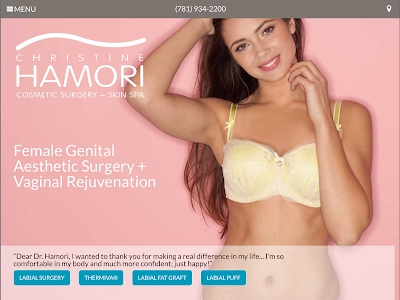
labiaplasty website screenshot

Dr. Hamori has developed a patient-focused website dedicated exclusively to Female Genital Aesthetic Surgery + Vaginal Rejuvenation. To visit, go to: LabiaplastyBoston.com.


April 04, 2017

Important Information about Breast Implants and BIA-ALCL

By Christine A. Hamori, MD

Recent media coverage of an FDA update regarding BIA-ALCL (Breast Implant Associated Anaplastic Large Cell Lymphoma) is causing a lot of concern among breast implant patients. First of all, patients should know that BIA-ALCL is not new, and that this is a very rare disease. Also, it is only associated with textured implants. During every breast augmentation consult I do with every potential patient, we go over this information. In fact, rarely do my patients and I choose a textured implant.

My colleague Dr. William Adams has published this informative update with a video from the Plastic Surgery Channel: An Update to Breast Implant-Associated ALCL.

The video is below for your viewing.


The bottom line, as spelled out in this report, is:
"Breast Implant-Associated ALCL is not new and there is excellent research and progress in reducing its occurrence and improving the treatment should it occur.  Here’s what patients should know:
  • It is a rare disease that appears to be associated with TEXTURED breast implants
  • If you notice significant swelling or changes in breast shape and size, call your plastic surgeon
  • If diagnosed and treated properly, it is curable
  • Patients desiring breast implants should know the difference between textured and smooth implants and discuss the best option for them with their surgeon."
I also recommend this in-depth post by another colleague, Dr. Karen Horton: ALCL and Breast Implants? The Rare Incidence of Anaplastic Large Cell Lymphoma

The FDA information page on ALCL has these recommendations for patients:
Educate yourself about breast implants before agreeing to surgery. Breast implants approved in the U.S. can be filled with either saline or with silicone gel. They come in different sizes and shapes and have either smooth or textured surfaces (shells). Additional information is available on FDA's Breast Implants website.

Although it is rare, BIA-ALCL appears to develop more frequently in women with textured implants than in women with smooth-surfaced implants. Before getting breast implants, make sure to talk to your health care provider about the benefits and risks of textured-surface vs. smooth-surfaced implants.

If you have breast implants, there is no need to change your routine medical care and follow-up. BIA-ALCL is rare. Although not specific to BIA-ALCL, you should follow standard medical recommendations including:
  • Follow your doctor's instructions on how to monitor your breast implants. If you notice any changes, contact your health care provider promptly to schedule an appointment. Get routine mammography screening and ask for a technologist specifically trained in performing mammograms on patients with breast implants.
  • If you have silicone gel-filled breast implants, get periodic magnetic resonance imaging (MRI) to detect ruptures as recommended by your health care provider. The FDA-approved product labeling for silicone gel-filled breast implants states that the first MRI should occur three years after implant surgery and every two years thereafter.
Additional Recommended Resources on BIA-ALCL:
Please explore these excellent resources, and, as always, if you have additional questions or note any swelling, please contact my office at 781-934-2200 to schedule a consultation.

Christine Hamori Cosmetic Surgery + Skin Spa
113 Tremont Street, Duxbury, Massachusetts, 02332
Call us: 781-934-2200
Serving Boston's South Shore, Cape Cod and Nantucket